Liquidity pools and LP tokens
Where impermanent loss comes from.
Educational content only — not investment advice. Independent and not affiliated with Uniswap Labs.
Before going anywhere near a decentralized exchange, it helps to understand what can go wrong. This article walks through the main risks in plain language, honestly and without sugar-coating.
Decentralized finance can feel exciting and new, but excitement is not a substitute for understanding. Protocols like Uniswap are run by code rather than by a company you can call, which changes the nature of the risks involved. This article is an independent, educational overview of those risks. It is not advice, and it does not tell you what to do with your money. Its only goal is to help you see clearly what you would be exposing yourself to, so that nothing comes as a surprise.
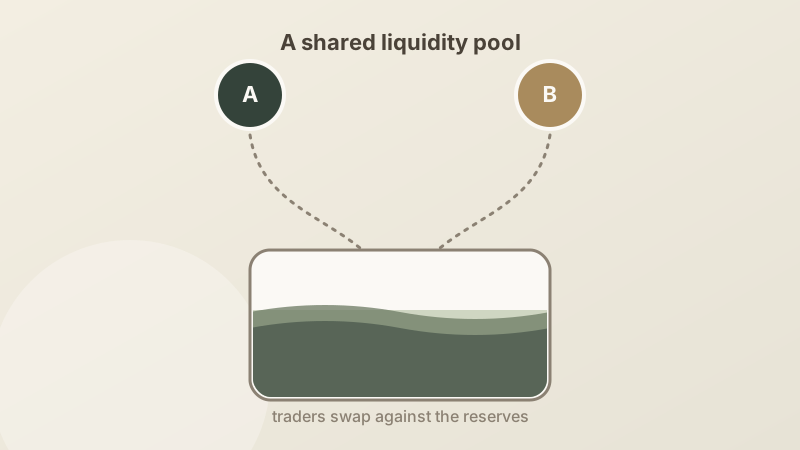
Impermanent loss is one of the least intuitive risks in DeFi, so it is worth slowing down. It applies when you provide two tokens to a liquidity pool. The term describes the difference in value between providing those tokens to a pool versus simply holding the same two tokens in your wallet. It appears when the prices of the two tokens in the pair move apart from one another.
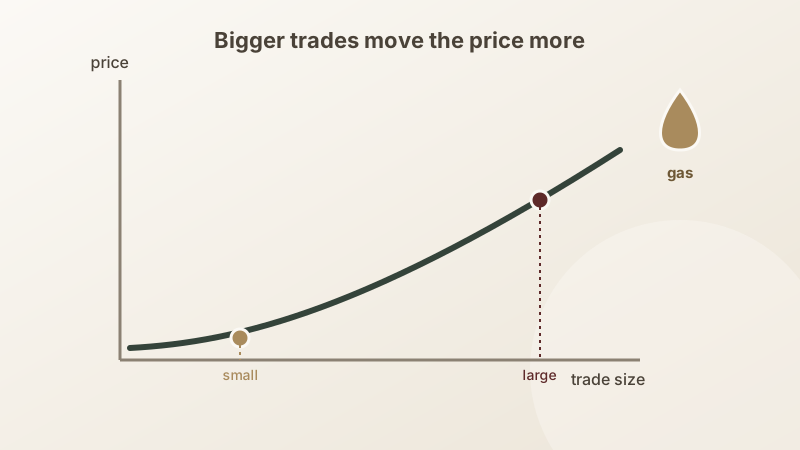
Here is the intuition. An automated market maker keeps a balance between the two tokens in a pool. When one token's price changes relative to the other, the pool automatically rebalances by selling some of the token that rose and accumulating more of the one that fell. So when you eventually withdraw, you may hold a different mix of tokens than you put in, and that mix can be worth less than if you had simply held the two tokens untouched.
Illustrative example only (invented numbers, not real prices): Imagine you deposit equal values of Token A and Token B. Later, Token A has doubled in price relative to Token B. Because the pool rebalanced along the way, your withdrawn position could be worth somewhat less than if you had just held both tokens in your wallet. That gap is the impermanent loss.
It is called impermanent because the gap can shrink, or even disappear, if the two prices drift back toward their original relationship. But once you withdraw, whatever gap exists at that moment becomes realized and permanent. Pools may charge fees to liquidity providers, and those fees might partly or fully offset the gap, or they might not. The outcome depends entirely on how prices move, and that cannot be known in advance.

A decentralized exchange is ultimately software. Software can contain bugs, and bugs can be exploited. If a flaw exists in the code that holds funds, it is possible for value to be lost, sometimes irreversibly. This is true even for well-known, widely-used protocols.
Many serious projects commission security audits, where independent reviewers examine the code for weaknesses. Audits are valuable, but they reduce risk rather than eliminate it. An audit is a snapshot in time by fallible humans; it cannot prove that code is free of every flaw. Importantly, on-chain transactions are typically immutable and irreversible. Once something executes on the blockchain, there is usually no undo button and no authority that can claw it back.
Not every risk lives inside the protocol's own code. A large share of losses in DeFi come from deception aimed at the user. Being skeptical by default is a reasonable posture here.
This is risk-awareness, not a checklist for staying safe. The broader point is simply that the absence of a central gatekeeper means much of the burden of caution falls on the individual.
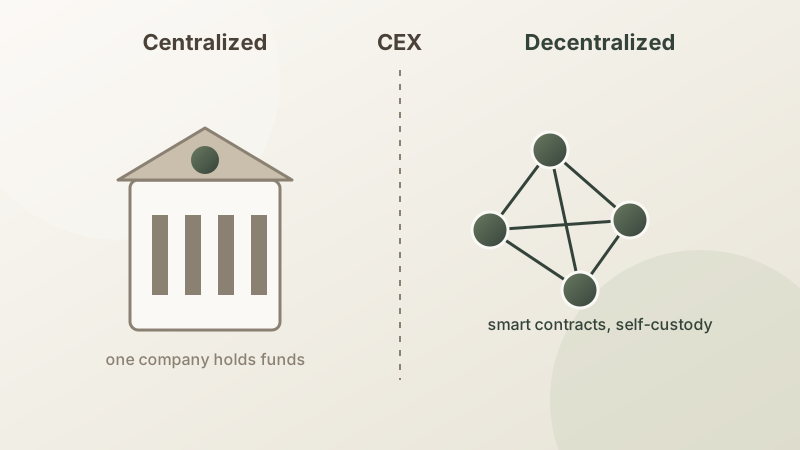
In DeFi, you typically hold your own keys, and those keys are the only thing that controls your funds. If you lose them, you lose access, often permanently. If you make a mistake, send funds to the wrong place, or fall for a scam, there is no support line, no password reset, and no institution that can reverse the transaction on your behalf. Self-custody puts you in control, and it also puts responsibility for that control entirely on you.
Finally, the assets involved can be highly volatile. Crypto-asset values can move sharply and quickly, in either direction, and there is a genuine possibility of losing the entire value of what you hold. No amount of technical understanding changes the fact that these are inherently uncertain assets, and nothing here should be read as a reassurance about outcomes.
This article is for education, not investment, financial, legal, or tax advice. It explains how these risks work, not what anyone should do about them.
Related reading: liquidity pools and LP tokens and how AMMs work.
Disclaimer: This article is educational content only. It is not investment, financial, legal, or tax advice, and not a recommendation to buy, sell, or trade any asset. Crypto involves significant risk, including total loss of funds.